

Serial Cables Expands Hydra Gen6 JBOF with Quarch Breaker Cards, Gen5 M.2/U.2 Support, Management GUI and a Python API
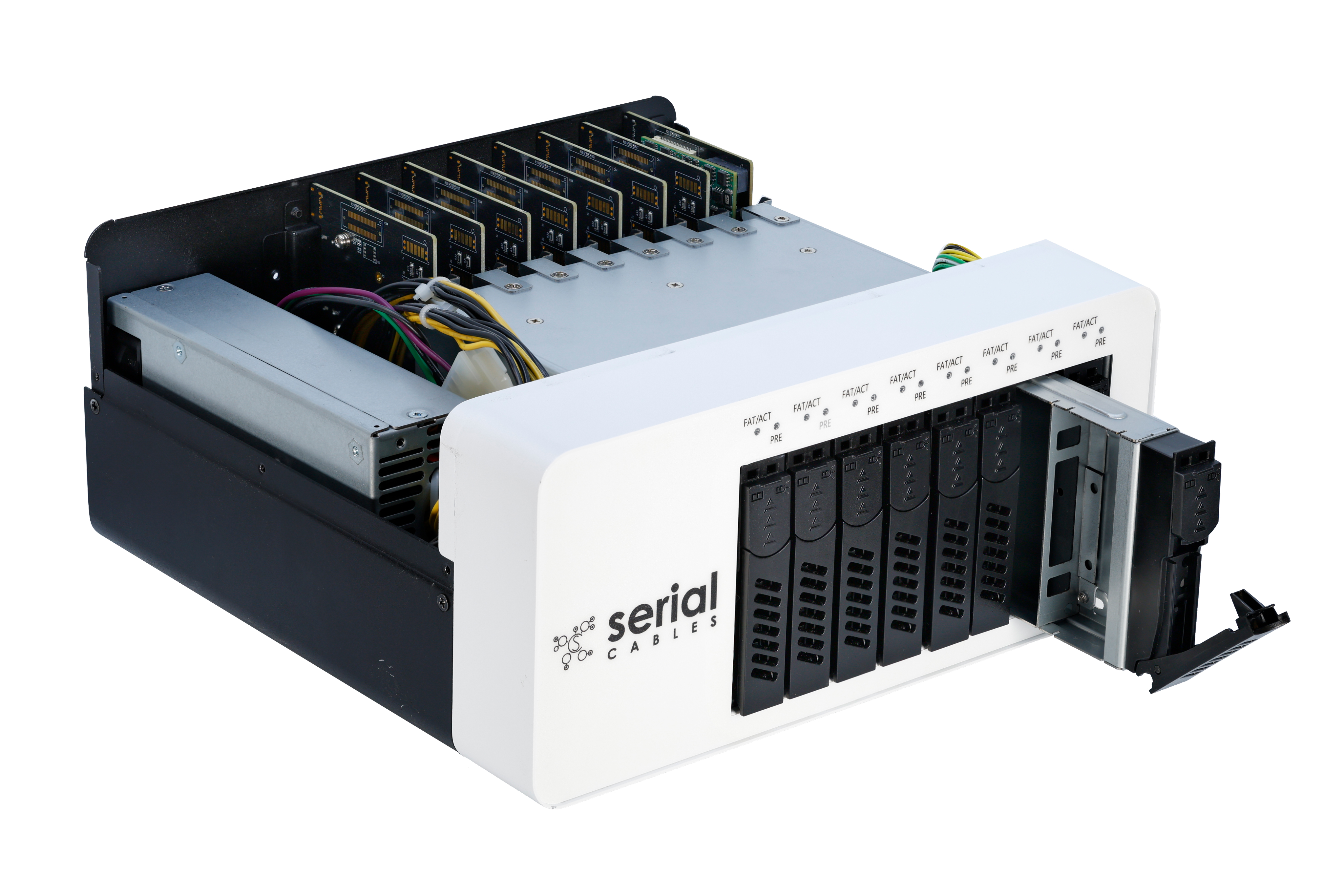
Hydra’s open 8 bay chassis supports all EDSFF drive formats (E3.S 2T, E3.L, and E3.L 2T) with a modular paddle card design and optional Quarch PAM and Breaker integration for precise, low loss Gen6 validation.
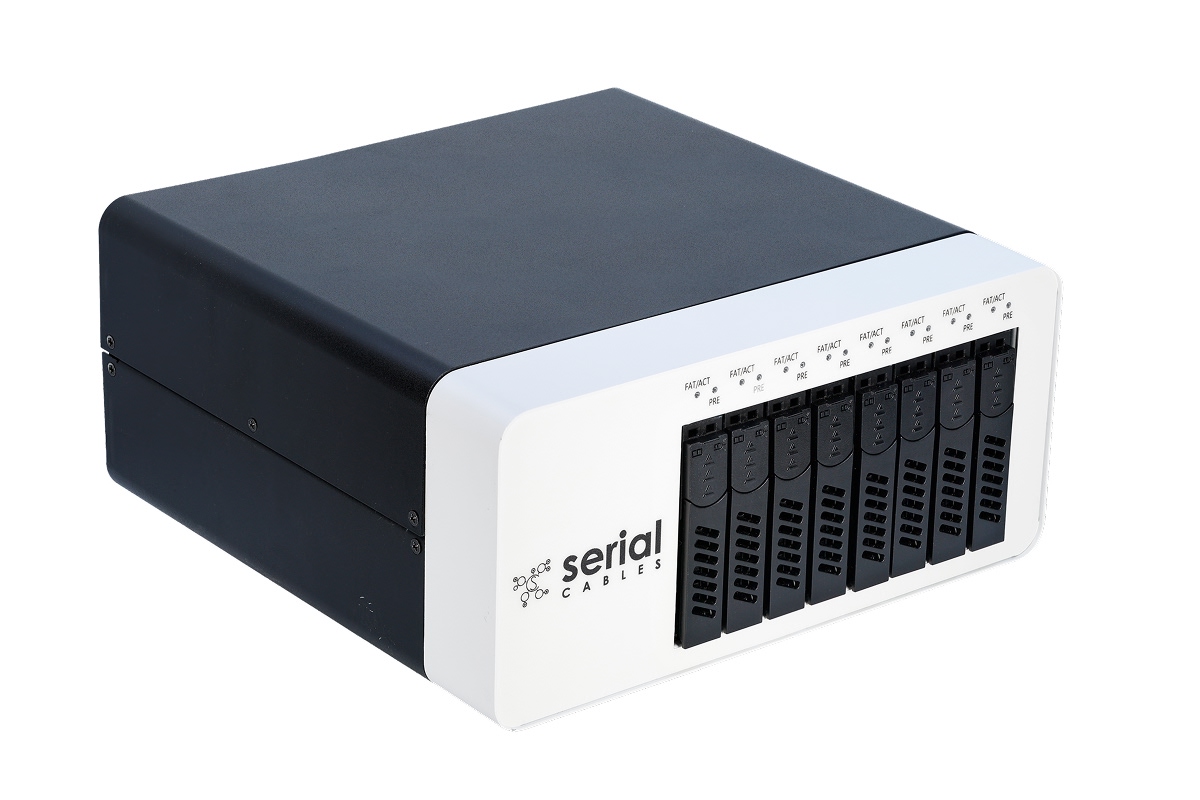
Serial Cables Hydra is a Gen6 JBOF solution for PCIe, NVMe, and CXL testing. It delivers a compact 8 bay enclosure designed specifically for validation workflows. in one clean testing toolchain agnostic, automated system
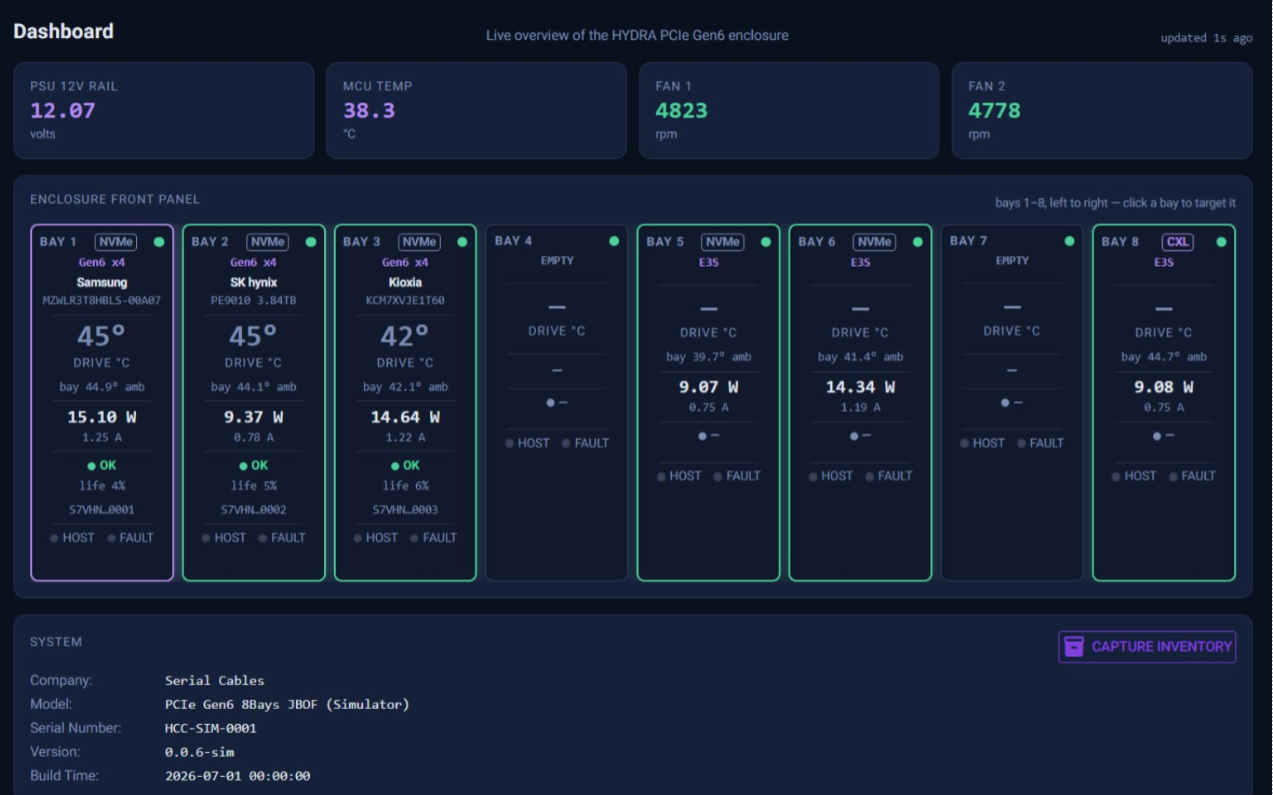
Hydra Command Center Dashboard showing active bays and drive metrics.
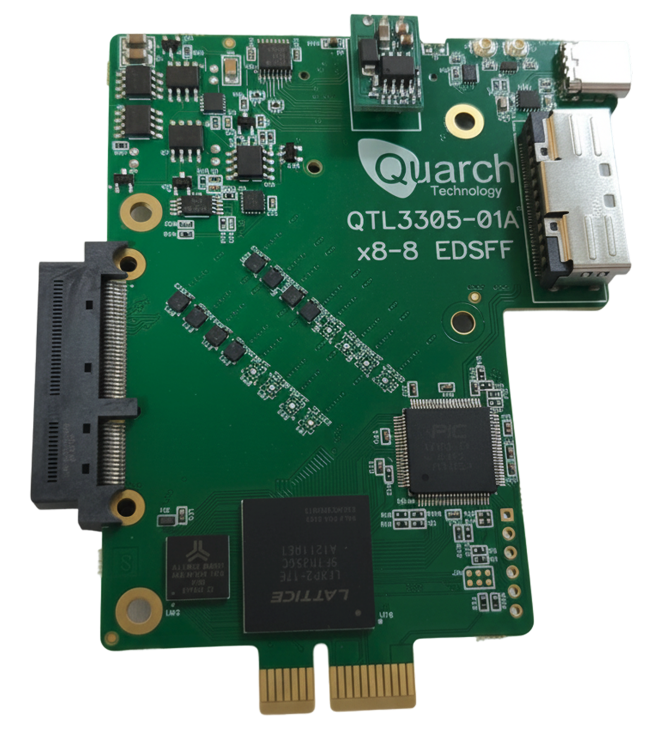
Paddle card with integrated Quarch breaker, Back
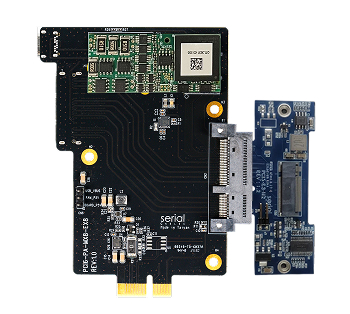
Paddle card with Quarch PAM mezzanine and M.2 to E3.S interposer for PCIe 5.0 drive testing
Serial Cables' Gen6 JBOF adds Quarch Breaker paddle cards, compatibility with M.2 and U.2 PCIe 5.0 drives, dedicated GUI, and a Python API library.
ENGLEWOOD, CO, UNITED STATES, July 15, 2026 /EINPresswire.com/ -- Serial Cables, a provider of high-performance interconnect and validation hardware for PCIe and CXL development, today spotlighted Hydra, the industry's first 8-bay Gen6 JBOF platform purpose built for PCIe, NVMe, and CXL validation.
Since shipping, Hydra has become a fixture on benches where PCIe 6.0 drives arrive earlier than the host platforms meant to test them. It now adds Quarch Breaker paddle cards, backward compatibility with M.2 and U.2 PCIe 5.0 drives, and a full Python API, CLI, and the new Hydra Command Center GUI for rapid troubleshooting.
Storage labs are being squeezed from both ends. PCIe 6.0 drives and devices are shipping while PCIe 6.0 host platforms remain scarce. New form factors & protocols like E3, E1, CXL 3.x land before the enclosures and fixtures that hold them exist. Meanwhile, engineering teams are already being asked to design for PCIe 7.0 and its far tougher signal integrity budget. Every hardware gap in that chain slows a program down, inflates cost, and drags out time to market.
Traditional test setups make it worse: open benches, loose cables, and desk fans introduce thermal variance and instability that make repeatable results hard to defend.
Hydra replaces those ad hoc setups with a compact, modular, instrumented enclosure. Hydra plugs into a PCIe 5.0 host in non-FLIT mode via a Serial Cables PCIe 6.0 host card and MCIO y-cables, presenting a stable PCIe 6.0 FLIT-mode link to eight compliant bays. Teams can qualify Gen6 drives today, on the hosts they already own, with room to insert interposers and analyzers in between.
Architecture and form factor
• 8-bay passive PCIe 6.0 x8 EDSFF JBOF for PCIe/NVMe and CXL
• EDSFF form factor support: E3.S 2T, E3.L, E3.L 2T
• New backward compatibility with legacy PCIe 5.0 drives: M.2 and U.2 devices drop into the same bays via interposer, so one enclosure covers both the Gen5 fleet already under test and the Gen6 parts arriving next
• Individual paddle card design: direct, low-loss connectivity to each drive, eliminating the SI compromises of a conventional Gen6 backplane at 64 GT/s
• New Quarch Technologies Breaker paddle cards join the Standard and Standard + Quarch PAM mezzanine options, adding controlled fault injection and hot-plug margining alongside per slot power analysis
• Toolchain agnostic: drive it from QPS, TestMonkey, or your own test scripts with QuarchPy
Connectivity, power, and cooling
• 8 × x8 PCIe 6.0 MCIO connectors wired directly to each slot
• Full sideband signaling: I²C with MCTP and I³C MCP
• 500W PSU with staggered power-up sequencing
• Dual 36CFM fans with CLI-based RPM control
• Front-panel LEDs for slot presence, activity, error, and pass/fail
New: Hydra API, CLI, and GUI
Hydra ships with a Python library for Gen6 JBOF control and NVMe validation — installable in one line: pip install serialcables-hydra
(Requirements: Python 3.8+ and a USB connection.)
Key capabilities:
• Slot control: per-slot power sequencing, reset (PERST#), disable, and hot-plug simulation
• Thermal management: SSD temperature monitoring and dual-fan RPM control
• Power telemetry: real-time current and voltage monitoring per slot
• Link monitoring: slot width and speed negotiation tracking
• NVMe-MI / MCTP: native sideband, out-of-band device management
• LED control: front-panel activity, error, and pass/fail indicators
• Telemetry export: data streaming and CSV logging for regression analysis
• QuarchPy integration: optional power analysis via Quarch PAM mezzanine cards, correlating power with protocol
• Automation: automated test sequencing across all eight drives, and API-level integration with third-party platforms
The new Hydra Command Center GUI puts the same data on one screen for quick troubleshooting: PSU rail voltage, MCU temperature, both fan RPMs, and a live front-panel view of all eight bays showing drive model, link generation and width, temperature, power draw, current, life percentage, serial number, and host/fault state with one-click inventory capture.
Part of a broader Serial Cables lab acceleration portfolio
Hydra sits alongside Serial Cables' PCIe 6.0 host cards (Microchip and Broadcom Atlas III silicon, in MCIO, CDFP, QSFP-DD, Ardent, and straddle-mount x16 variants), vertical and horizontal EDSFF adapters, Gen6/CXL 3.x retimers and redrivers, M.2-to-E3 adapters that cut the cost of consumable test drives, and validated Gen6 and Gen7 cabling, including a Gen7 x16 ACC CDFP cable at 128 GT/s PAM4 and CDFP/OSFP-XD AOCs for long reach links. Serial Cables is also the exclusive Quarch reseller for the U.S. and Mexico.
Availability
Hydra (SKU: PCI6-ENC8-E3-08) is available now. For demo requests, datasheets, pricing, or early-access program information, contact sales@serialcables.com.
ABOUT SERIAL CABLES
Serial Cables is a trusted provider of PCIe and CXL validation hardware. The company is known for early-access innovation, responsive support, and purpose-built tools for hyperscale, enterprise storage, and silicon validation environments. Serial Cables focuses on short lead times, collaborative engineering, and delivering proven hardware that accelerates time-to-market.
Paul J Mutschler
Serial Cables
+1 303-810-5110
email us here
Visit us on social media:
LinkedIn
Legal Disclaimer:
EIN Presswire provides this news content "as is" without warranty of any kind. We do not accept any responsibility or liability for the accuracy, content, images, videos, licenses, completeness, legality, or reliability of the information contained in this article. If you have any complaints or copyright issues related to this article, kindly contact the author above.
